A turbogenerator stator is comprised of two major components.
What are stator laminates made of.
With the eddy current reduced the stator core can maintain constant power keeping your motor running.
1 the stator windings and 2 the stator core.
Stator laminations reduce eddy current by insulating the core.
A turbogenerator stator is comprised of two major components.
Few decisions in the design of an electric motor are as fundamental or have as far reaching consequences as the selection of the material to be used in the rotor or stator laminations.
1 the stator windings and 2 the stator core.
As such there is a need to laminate the stator core and insulate each layer.
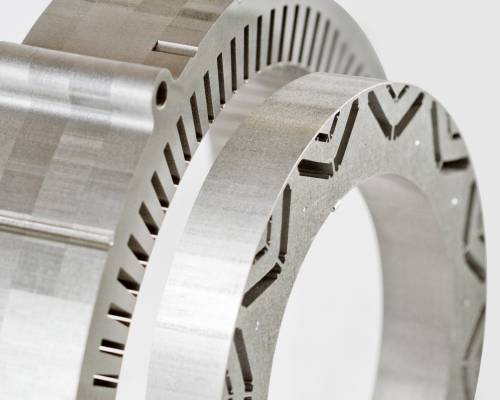
Laminations are the steel portions of the stator and rotor consisting of thin lamination sheets stacked together.
These laminations can be stacked loose welded or bonded together depending on your application.
Thin silicon steel plates are stacked on top of one another around the center preventing eddy current flow.
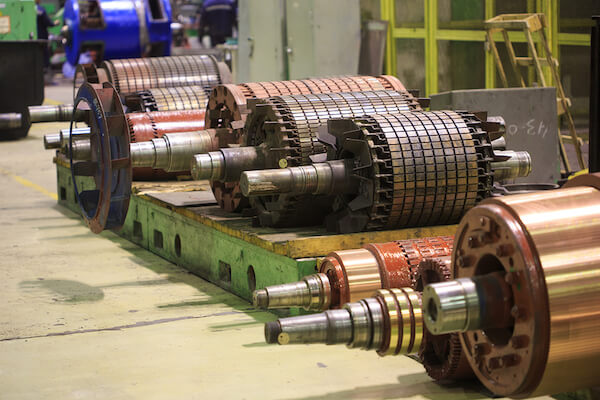
The stator core is made up of thousands tens of thousands or hundreds of thousands of individual steel laminations.
Laminations sheets are used instead of a solid pice to reduce eddy current losses.
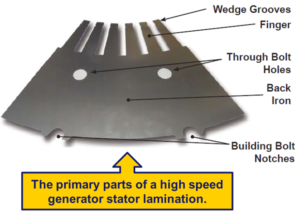
The inner surface of the stator is made up of a number of deep slots or grooves around the stator.
Cools the stator core.
Modern laminations are comprised of silica steel cold rolled and grain oriented as specific designs might require.
In an electric motor the stator provides a rotating magnetic field that drives the rotating armature.
In a case scenario where the stator core is made from solely one solid piece of material the associated heat produced and currents will amount to a large sum resulting in a melted stator core.
Why is the stator core laminated.
Motor output heat rise weight and cost are only a few of the characteristics which are profoundly influenced by the selection of core material.
The stator is the stationary part of a rotary system found in electric generators electric motors sirens mud motors or biological rotors energy flows through a stator to or from the rotating component of the system.
The stator core is made up of a stack of round pre punched laminations pressed into a frame which may be made of aluminium or cast iron.
In a generator the stator converts the rotating magnetic field to.