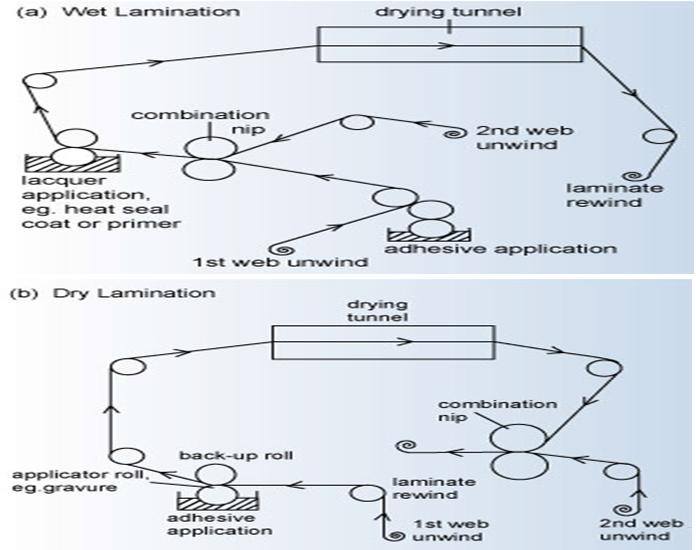
Where the bonding agent is still in a liquid state when the webs are joined together.
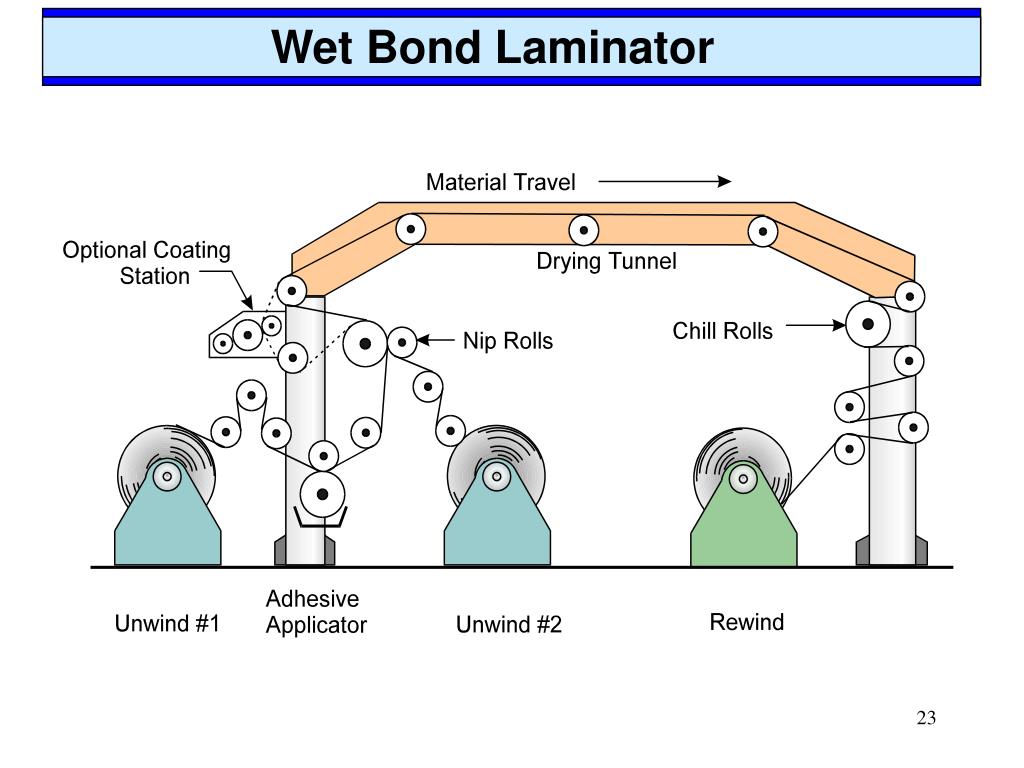
Wet bond lamination process.
This process was deemed inconvenient and by 1948 progress was made in dry lamination using polyvinyl acetate plasticized with dibutyl phthalate.
Flexible future 2002 they are 100 solid materials that melt to the liquid phase when they are heated to the temperature ranges of 80 200 c and solidify to form bonding when they cool glawe et al 2003.
One of the first applications was laminating light gauge aluminum foil to tissue using either casein or sodium silicate adhesives.
Wet bonding refers to any process where a liquid adhesive is applied to a substrate that is then immediately combined with a second ply to create a laminate.
Dry bonding wet bonding uv eb curing and hot melt adhesion processes table 4 2 6.
Hot melt lamination uses hot melt adhesives instead of solvent or water based adhesives laminating and coating.
It is commonly used to produce a paper aluminum foil laminate that is widely used in flexible packaging.
In this process the combining agents are kept in liquid form when substrates are needed to be combined.
For example a foil and paper substrate lamination may be accomplished through a wet bonding process.
In the 1930s a wet lamination process with the use of solvents was used to bond shirt collars a woven fabric with cellulose acetate.
Wet lamination is best for the production of aluminum foil or paper laminate where the material is also flexible.
These processes are classified under four categories.
Shim in joining textiles 2013.
The process differentiation is defined by the type of adhesive used and how the adhesive is applied and converted.
10 4 3 hot melt lamination.
Laminating machinery can be classified according to the type of bonding agent used to produce the laminates.
The adhesive lamination process utilizes adhesive to bond two substrates.
Once the wet bonding process is applied to each substrate the two substrates will then be combined prior to passing through an.